Optical Glass Materials Guide: BK7, Fused Silica, Quartz and More
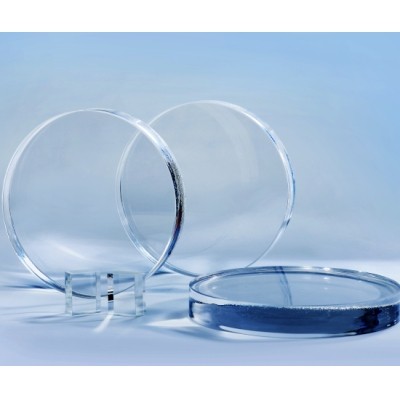
The substrate is the foundation of every optical component. Its refractive index, dispersion, transmission range and mechanical properties set the limits of what a lens, window or filter can achieve. Choosing the right optical glass is therefore one of the first and most consequential decisions in any design.
Borosilicate crown glass, often referred to by the Schott designation BK7, is the general-purpose workhorse of visible optics. It offers good transmission from about 350 nm into the near-IR, moderate refractive index and low cost, and it is easy to grind and polish. Most visible filters, including our coloured glass line, are built on economical glass of this family.
Fused silica is the premium choice when the application demands more. It transmits deep into the UV, has very low thermal expansion, withstands high laser power and shows minimal autofluorescence. It is the standard substrate for excimer and UV laser optics, high-power mirrors and fluorescence filters. Our double-sided AR quartz glass is built on fused silica.
Quartz and fused silica are often confused. Synthetic fused silica is the high-purity, high-performance material used in precision optics; natural quartz and cheaper quartz glasses have higher impurity levels and stronger absorption in the UV. For critical work, specify fused silica explicitly rather than accepting a generic 'quartz' designation.
Dispersion matters for imaging. It is commonly quantified by the Abbe number: a high Abbe number means low dispersion and less chromatic aberration, while flint glasses with low Abbe numbers bend light strongly but spread the colours. Achromatic designs pair a crown and a flint glass to cancel chromatic error.
For infrared work, standard glasses become opaque. Materials such as infrared glass HWB-760, sapphire and various chalcogenide or germanium glasses are used instead. Sapphire is exceptionally hard and transmits from the UV into the mid-IR, which is why it appears in demanding windows such as our sapphire windows.
UV applications need special attention. Below about 300 nm, many glasses absorb strongly and even fused silica begins to show absorption bands depending on purity. UV-grade fused silica and materials such as UV glass ZWB1/ZWB3 are selected for their transmission in this region.
Colour filters deserve a mention as a separate category. Rather than relying on thin-film interference, they use ions dispersed in the glass to absorb specific wavelengths. Types such as HB red glass and CB535 yellow glass are rugged, inexpensive and angle-insensitive, though less sharp than interference filters.
Mechanical and thermal properties frequently decide the real choice. Consider hardness and scratch resistance, thermal expansion, chemical durability and how the substrate will be mounted. A material with ideal transmission but poor thermal stability can fail in a high-power or outdoor environment.
Tell us your wavelength range, power level, environmental conditions and tolerance requirements. Our team can recommend the right substrate from our optical glass range and supply matching coatings and measured transmission data.