Optical Filter Types: A Complete Guide to 8 Common Categories
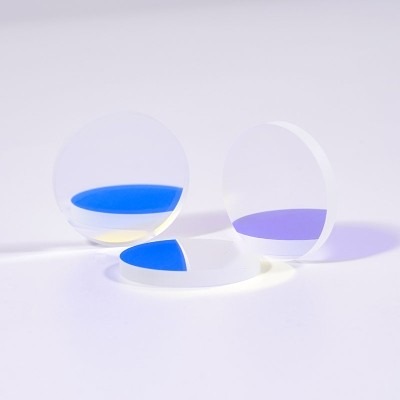
Optical filters are described by a confusing variety of names, but almost all of them fall into a handful of categories. Once you understand these families, specifying a filter becomes far simpler — and you are much less likely to order the wrong part.
Longpass filters transmit wavelengths above a cut-on and block those below. They are used to pass a longer-wavelength emission while rejecting a shorter excitation. Our LP590 and LP500 are typical examples, and the whole family is collected in our longpass filters range.
Shortpass filters do the opposite: they transmit below a cut-off and block above. They are used to remove infrared light from a colour camera or to pass a short emission. The SP460 shortpass filter and the IR-cut filter illustrate the two main uses.
Bandpass filters transmit only a defined window of wavelengths and block everything on either side. They are the choice when you want to isolate a specific spectral line, such as a laser line or a fluorescence emission channel. They are specified by centre wavelength and bandwidth (FWHM).
Notch filters reject a narrow band while transmitting almost everything else. They are useful for removing a specific unwanted line — for example a laser line in a Raman system — while keeping the rest of the spectrum intact.
Neutral density (ND) filters reduce the intensity of light across a broad range without changing its colour balance. They are used to protect detectors, control exposure or attenuate a bright beam. They are specified by optical density rather than a wavelength edge.
Dichroic mirrors are edge filters used at an angle to separate or combine wavelengths. They reflect one band and transmit another, making them indispensable in fluorescence and projection systems. See our dichroic mirror range.
Coloured glass filters absorb light by virtue of ions dispersed in the glass itself rather than a thin-film coating. They are rugged, inexpensive and angle-insensitive, with softer transitions — examples include HB red glass and CB535 yellow glass.
Mirrors and beamsplitters are sometimes grouped with filters because they also manipulate light by wavelength or intensity. A polarising beamsplitter separates polarisation states; a gold mirror reflects broadband infrared light efficiently.
To choose well, start with the wavelengths to pass and block, then decide how steep the edge must be, how deep the blocking needs to be, and what substrate and coating the environment demands. Tell us those parameters and we will point you to the right category and part.