Optical Coating Types Compared: AR, HR, Dichroic and Protective
An optical coating is a microscopic layer, or stack of layers, deposited on a surface to control how light behaves there. Almost every precision optic depends on one. Knowing the main coating families makes datasheets far easier to read and helps you specify parts with confidence.
Anti-reflection (AR) coatings reduce unwanted reflection from a surface, raising transmission. An uncoated glass surface reflects about 4% of incident light; a good AR coating brings that below 0.5%. They are used on lenses, windows and filters — see our AR quartz glass and the SP460+AR filter.
High-reflection (HR) coatings do the opposite, maximising reflectance at a chosen wavelength. Made from alternating high- and low-index layers, they can exceed 99.9% reflectance at a laser line. Our laser steering mirror and UV mirror use HR designs.
Dichroic coatings are engineered to reflect one spectral band while transmitting another. They sit between AR and HR in concept but are designed for spectral separation rather than maximum reflection. Our fluorescence dichroic mirror and RGB beam-combining mirrors use this approach.
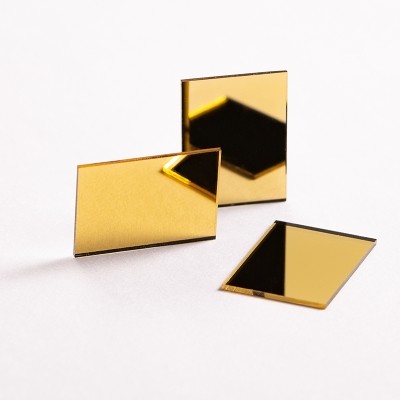
Metal coatings reflect broadly across a wide range using a thin metallic film. Silver, gold and aluminium mirrors offer high broadband reflectance with less angle and polarisation sensitivity than dielectric designs, though with somewhat lower peak reflection and damage threshold.
Protective coatings shield a soft substrate or a metal film from scratches, moisture and oxidation. A protective overcoat on a silver mirror, for example, dramatically improves durability without significantly changing its reflectance. They are essential in harsh or outdoor environments.
Beamsplitter coatings are designed to divide light in a defined ratio or by polarisation. A 50:50 splitter coating reflects and transmits roughly equally, while a polarising splitter separates polarisation states.
Deposition method matters as much as design. Ion-assisted deposition (IAD) and plasma-assisted techniques produce dense, hard, stable films that tolerate cleaning and humidity. Soft evaporated coatings are cheaper but less durable — an important distinction for production optics.
Every coating is designed for a wavelength range, angle of incidence and polarisation. A coating optimised for 1064 nm at normal incidence may perform poorly at 532 nm or 45°. Always give your supplier these conditions and ask for a measured spectral curve.
Tell us what you need the optic to do — transmit, reflect, separate or protect — along with your wavelength, angle and environment. We will recommend the coating type and provide measured performance data.